The Execution Strain in Industrial Construction
When Capability Lags Behind Capital
Steel plants are expanding capacity. Cement units are scaling production. Power plants are racing toward commissioning. Semiconductor fabs are demanding precision at micron levels.
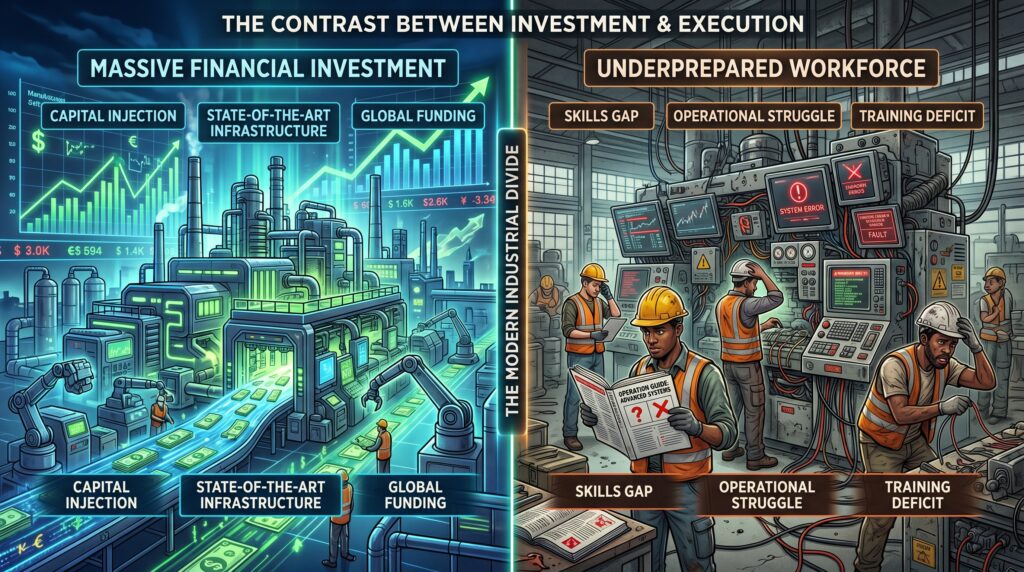
Industrial construction has entered an era of unprecedented capital intensity, technical depth, and system complexity. On paper, projects are well-funded, well-scoped, and strategically vital. On the ground, execution tells a different story.
Delays. Rework. Coordination failures. Commissioning bottlenecks. Productivity loss. Cost escalations.
And behind all of this lies a challenge the industry still underestimates: the misalignment of people with execution.
Industrial projects today are not merely large. They are deeply interdependent, precision-driven, and highly sensitive to sequencing.
A steel plant demands heavy mechanical execution integrated with continuous process systems. A cement unit relies on tightly coordinated multi-stage equipment installation. A power project depends on synchronization across electrical, thermal, control, and commissioning systems. Semiconductor facilities operate in ultra-precision environments where even microscopic deviations have serious consequences.
Execution in such environments is no longer linear. It is multi-disciplinary, parallel, phase-sensitive, and unforgiving.
Yet, the workforce models supporting these projects are still largely designed for more predictable and linear delivery environments.
That is where the strain begins.
Complexity Without Cohesion
Industrial construction does not fail for lack of funding alone, nor does it struggle because engineering knowledge is absent.
It struggles because execution on the ground is often not matched by:
- Phase-relevant capability
- Synchronized deployment
- Accountable coordination
Projects are frequently ready to begin, but critical expertise is not in place.
Specialized engineers in process systems, commissioning, instrumentation, or controls are difficult to mobilize at the exact moment they are needed. Deployment delays at the front end slow the entire project rhythm before momentum is even established.
When execution begins, another layer of strain emerges.
General manpower is often pushed into environments that demand specialized supervision. Critical installations proceed without the level of experienced oversight required for first-time-right outcomes.
Mechanical, electrical, instrumentation, and control systems do not merely need manpower; they need competence aligned to risk, sequence, and integration intensity. As a result, assets may be built, but not always built right the first time.
Commissioning Is Where the Truth Emerges
Commissioning is not just a milestone in industrial construction. It is the moment where every earlier execution decision is tested.
By this stage, the margin for error has narrowed. System interdependencies are at their peak.
Mechanical installation, electrical readiness, instrumentation integrity, control logic, and process integration must converge:
- In the right sequence
- At the right standard
- With the right people on site
If specialists are unavailable, if disciplines are not aligned, or if earlier execution gaps remain unresolved, the entire project begins to stall.
This is where rework escalates. This is where delays compound. This is where investor confidence, client expectations, and capital efficiency begin to erode.
The Coordination Problem
Industrial construction is delivered through a dense ecosystem of:
- EPC contractors
- OEM vendors
- Process specialists
- Control system integrators
- Consultants
- Client engineering teams
In principle, this should create collective strength. In practice, it often creates diffused accountability.
Roles overlap. Decisions slow down. Reporting structures grow, but ownership weakens.
Each stakeholder may be performing its part, yet execution remains fragmented because no one is sufficiently anchoring on-ground synchronization across systems and phases.
Everyone is working—but not always in alignment.
This becomes even more visible during phase transitions.
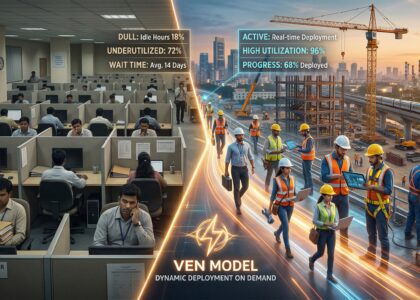
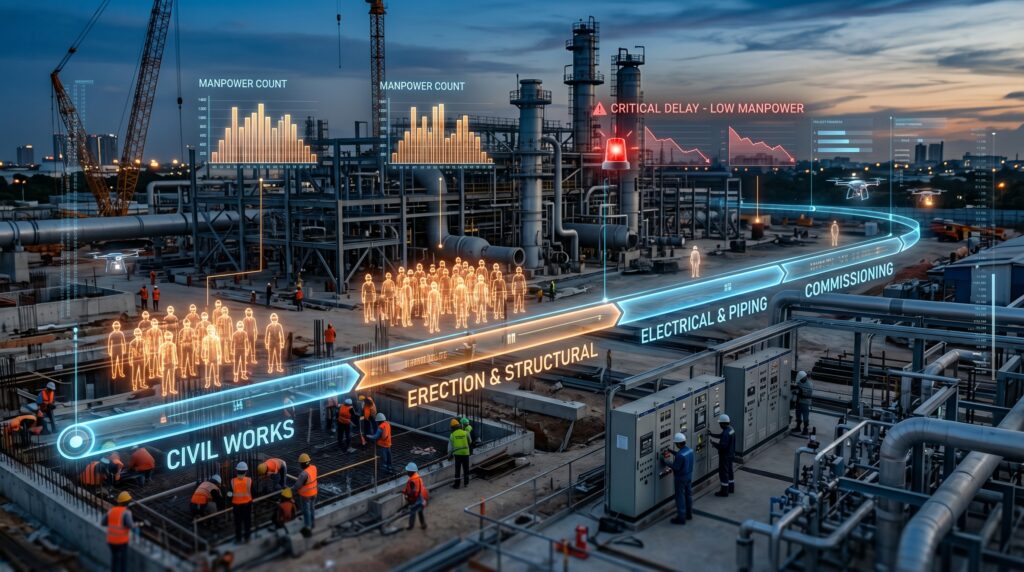
Industrial projects move across civil, structural, erection, electrical, instrumentation, testing, and commissioning stages—each demanding different expertise and intensity. Yet workforce deployment often remains continuous rather than strategic, leading to shortages at critical moments and inefficiencies in early stages.
Where Conventional Models Fall Short
The staffing model solves for availability. It is scalable, fast to mobilize, and commercially attractive across project sizes.
But availability is not the same as execution readiness.
Skill alignment is inconsistent, ownership remains limited, and monitoring is largely reactive.
The PMC model solves for structure. It provides process discipline and reporting rigor.
But it is often cost-heavy, slower to mobilize, and less adaptable to dynamic site conditions.
This is the invisible gap in industrial construction today.
Staffing brings availability. PMC brings structure. But neither consistently delivers synchronized execution across complex systems.
The Real Blind Spot: Capability Misalignment
Industrial construction is not fundamentally a headcount problem. It is a capability alignment problem.
The real question is not how many people are deployed. The real question is:
Which capability, at what phase, across which systems?
When that question is not answered well:
- Early stages carry idle resources
- Critical phases face talent shortages
- Commissioning teams arrive too late
- Issue detection slows
- Corrective actions lag
Behind every delay sits a people issue—teams present, but not synchronized.
Industrial Construction Has Entered a Different Era
The next phase of industrial growth will be defined by:
- Larger investments
- Tighter timelines
- Higher automation
- Stronger expectations around execution certainty
Execution can no longer depend on generic manpower or rigid oversight.
It requires:
- Precision in deployment
- Phase-aligned capability
- Real-time coordination and monitoring
In short, it requires a stronger execution layer.
From Execution Strain to Execution Precision
This is where VEN’s Owner’s Engineer model creates distinction.
VEN does not replace EPC. It does not replicate PMC.
It strengthens the most critical layer—execution on ground, where projects are won or lost.
The model aligns capability with complexity, phase, and sequencing. It deploys execution-ready engineers across disciplines, ensures phase-aligned workforce strategy, and enables real-time coordination across stakeholders.
The objective is not to add cost layers.
The objective is to remove execution gaps.
The Business Impact
When execution is aligned:
- Timelines accelerate
- Rework reduces
- Coordination improves
- Commissioning becomes predictable
- Capital efficiency strengthens
Execution becomes not just effective—but scalable and repeatable.
The Strategic Shift
The future of industrial construction will not be defined by investment size or engineering capability alone.
It will be defined by execution efficiency across complex systems.
Industrial construction does not need more people.
It needs:
- The right capability
- At the right phase
- In the right sequence
- Across the right systems
That is the difference between execution strain and execution precision.
And in a world where systems are interconnected and timelines are compressed—
Execution is the differentiator.
VEN Consulting India Pvt. Ltd.
Empowering People. Enabling Projects.