
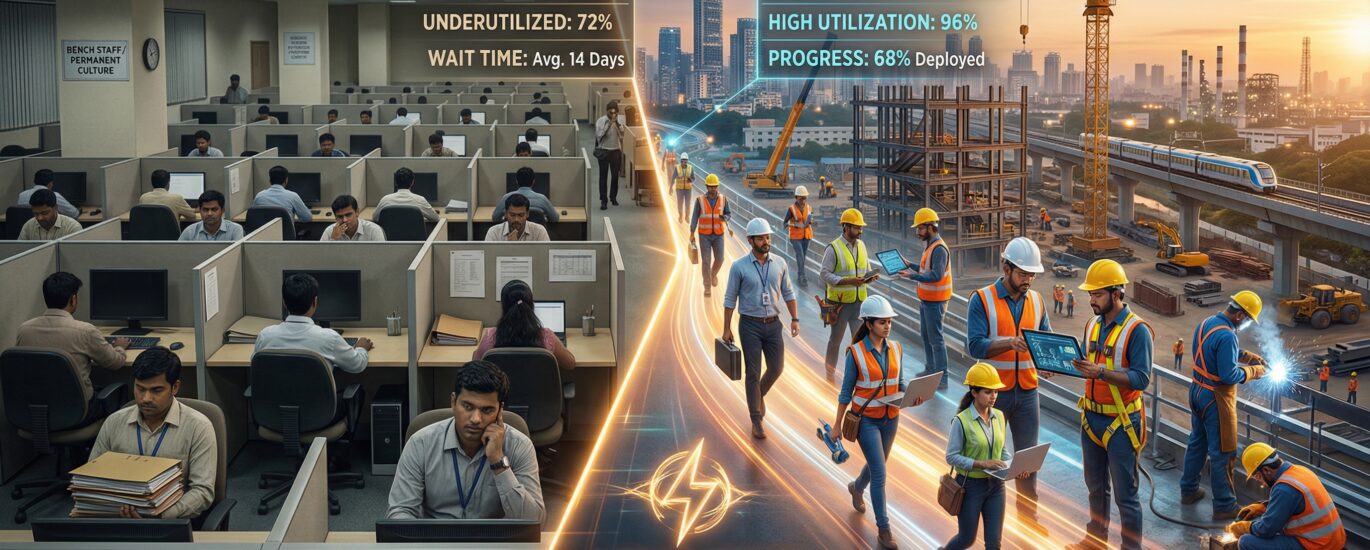
The Changing Face of Employment in India: From Stability to Agility Where Owner’s Engineering Bridges the Gap Between Staffing and PMC
For years, India’s employment landscape was built on permanence. Organizations hired for stability, employees stayed for security, and roles were designed for continuity.
But today, projects are no longer linear. They are fast, complex, capital-intensive, and constantly evolving. Timelines are compressed, margins are tighter, and execution failures are costlier than ever before.
In this new reality, the way organizations build their workforce is fundamentally changing.
The shift is clear—
from permanent employment → to agile, project-linked engagement.
But this transition is not just about how people are hired.
It is about how projects are delivered.
The Three Models of Execution: Staffing vs PMC vs Owner’s Engineer
As organizations adapt to this shift, three distinct models have emerged in project execution:
1. Traditional Staffing Model – Availability Without Accountability
Staffing provides manpower. It solves the problem of numbers.
- Quick deployment
- Cost-effective at surface level
- Flexible workforce
But the limitation is equally clear:
- Limited ownership
- Minimal value addition
- Dependency on client-side leadership
- Execution quality varies widely
Staffing fills positions.
It does not necessarily strengthen execution.
2. PMC (Project Management Consultant) – Ownership at a Cost
PMC models bring structured project management with defined deliverables.
- End-to-end responsibility
- Established systems and processes
- Defined accountability
However:
- High cost structures
- Longer onboarding cycles
- Reduced flexibility once engaged
- Often over-engineered for dynamic project environments
PMC ensures control—but at a premium, and sometimes at the cost of agility.
3. Owner’s Engineer Model – The Agile Middle Ground
This is where the shift in employment and execution truly converges.
The Owner’s Engineer model is not about providing manpower.
And it is not about taking over the project.
It is about deploying high-quality, execution-ready professionals who act as an extension of the owner’s intent.
At VEN, this translates into:
- Engineers and specialists who bring PMC-level capability
- Deployed with the speed and flexibility of staffing
- Operating under client control, but with strong execution ownership
This model delivers:
- Agility of staffing
- Capability of PMC
- Cost efficiency of optimized deployment
Why the Shift Toward Owner’s Engineering Is Inevitable
As employment becomes project-based, organizations no longer want:
- Fixed overheads without utilization
- Generic manpower without accountability
- Rigid consulting models without flexibility
They want:
- Capability on demand
- Execution ownership without long-term lock-in
- Speed without compromising quality
This is exactly where Owner’s Engineering fits.
It aligns with the new employment philosophy:
- Hire for need, not for permanence
- Deploy for impact, not for presence
- Scale for projects, not for hierarchy
VEN’s Perspective: Redefining Workforce as a Strategic Lever
At VEN Consulting India Pvt. Ltd., we see this shift not as a trend—but as a transformation.
Our approach is built on a simple belief:
Projects don’t fail due to lack of manpower.
They fail due to lack of the right capability at the right time.
That is why we focus on:
- Deploying engineers who understand execution, not just roles
- Enabling immediate contribution, not prolonged onboarding
- Strengthening project outcomes, not just filling positions
With:
- Faster deployment timelines
- Structured reporting and documentation systems
- Continuous safety and technical training
- Real-time attendance and monitoring frameworks
We ensure that agility does not compromise governance.
The New Definition of Workforce Strength
The future of employment in India is not about how many people you employ.
It is about:
- How quickly you can deploy capability
- How effectively your teams can execute
- How efficiently you can scale up and down
Organizations that continue to rely only on permanent structures will struggle with speed.
Those that rely only on staffing will struggle with quality.
Those that rely only on PMC will struggle with cost and flexibility.
The winners will be those who balance all three—strategically.
India is not just moving from permanent to project-based employment.
It is moving from resource thinking to capability thinking.
Staffing gives you people.
PMC gives you control.
Owner’s Engineering gives you execution.
And in a world driven by timelines, cost pressures, and delivery expectations—


