
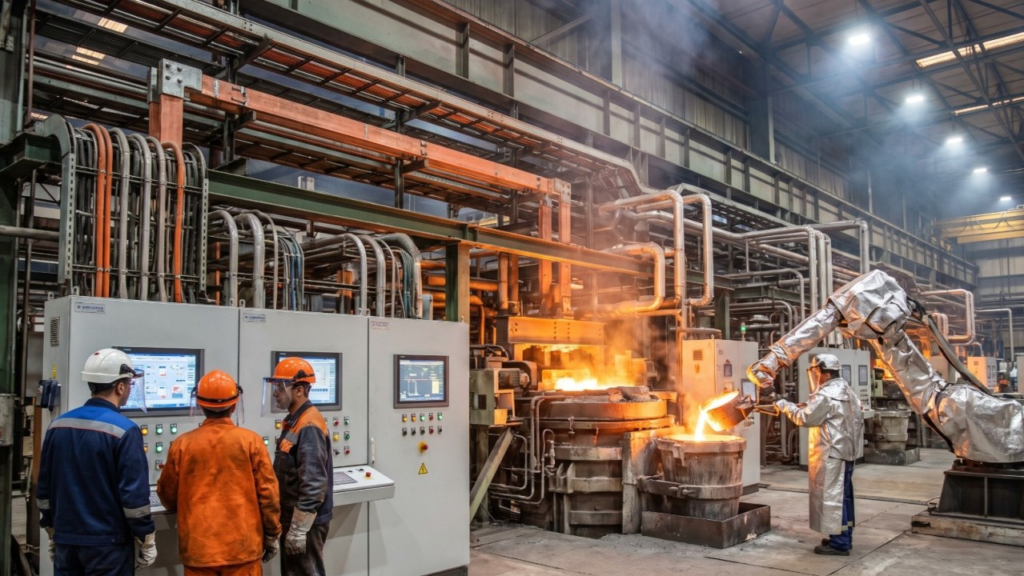
By 2026, the steel industry stands at the edge of its biggest transformation since the invention of the Bessemer converter.
Steel is the backbone of modern civilization. From skyscrapers and railways to automobiles and renewable energy infrastructure, the world produces over 1.9 billion tonnes of steel annually. However, traditional steel making remains responsible for approximately 7–11% of global CO₂ emissions, making it one of the largest industrial polluters on Earth.
Today, several breakthrough technologies are competing to redefine steel production. Among them, one technology has the potential to become the biggest revolution in steel making history.
Molten Oxide Electrolysis (MOE): Making Steel Using Electricity Alone
Molten Oxide Electrolysis (MOE) eliminates coal, coke ovens, blast furnaces, sinter plants, and even direct reduction processes.
Instead, iron ore is placed into a high-temperature electrolytic reactor where electricity directly separates iron from oxygen. The by-product is pure oxygen—not carbon dioxide.
How It Works
- Iron ore is melted inside an oxide electrolyte.
- Electricity passes through the molten material.
- Oxygen is released at the anode.
- Liquid iron collects at the bottom.
- Steel is produced with almost no direct carbon emissions.
The process effectively converts steel making from a chemical reduction industry into an electrical manufacturing industry.
Why This Could Be Revolutionary
Current Steel Plant Structure
A typical integrated steel plant requires:
- Coke ovens
- Sinter plants
- Blast furnaces
- Basic oxygen furnaces
- Coal handling systems
- Carbon capture systems (future)
These facilities cost billions of dollars and occupy enormous land areas.
MOE combines much of this into a single electrochemical process.
Production Impact (Projected)
Current technology is still in pilot and demonstration stages.
However, if industrial-scale MOE succeeds, experts expect:
MetricTraditional BF-BOFFuture MOECO₂ emissions~1.8–2.1 t/t steelNear-zeroCoal consumptionVery highNoneProcess steps5–7 major stages1–2 stagesRenewable integrationDifficultDirectAutomation potentialModerateVery High
Potential Capacity Revolution (Mtpa)
Current Situation
The world’s largest steel plants typically operate between:
10–30 MTPA (million tonnes per annum)
A new integrated plant can cost $5–15 billion.
Hypothetical MOE Future
If commercial MOE modules achieve scale:
YearEstimated Global MOE Capacity2026Pilot scale (<0.1 Mtpa)20305–20 Mtpa203550–150 Mtpa2040250–500 Mtpa
These are projections based on industrial scaling trends, not committed industry forecasts.
The Other Contender: Hydrogen Steel
While MOE attracts attention, the most commercially advanced technology today is:
Hydrogen Direct Reduced Iron (H₂-DRI)
Instead of coal, hydrogen removes oxygen from iron ore.
Reaction:
Iron Ore + Hydrogen → Iron + Water Vapor
This reduces CO₂ emissions by up to 90–95% when green hydrogen is used. Multiple large projects are already under development globally.
Expected Capacity Growth
TechnologyCurrent StatusHydrogen DRICommercial deployment beginningMOEPilot / demonstrationHIsarnaDemonstration scaleCarbon Capture BFEarly deployment
What Could Change the Industry Forever?
Imagine a future steel plant:
- No coal yard
- No coke ovens
- No blast furnaces
- Powered entirely by renewable electricity
- Producing oxygen instead of CO₂
- Built as modular production units
Such facilities could be located near solar parks, offshore wind farms, or even future nuclear microreactors.
If MOE reaches commercial maturity, it could become the equivalent of what electric vehicles did to internal combustion engines—a complete redesign rather than an incremental improvement.
Conclusion
The most disruptive steel technology under development in 2026 is Molten Oxide Electrolysis (MOE).
While hydrogen steel making is likely to dominate the next decade because it is closer to commercial deployment, MOE has the potential to completely eliminate carbon-based iron making and reshape the economics of steel production worldwide.
If successfully commercialized at scale, MOE could enable hundreds of millions of tonnes of near-zero-emission steel production annually and become the most significant steel making innovation since the blast furnace itself.