
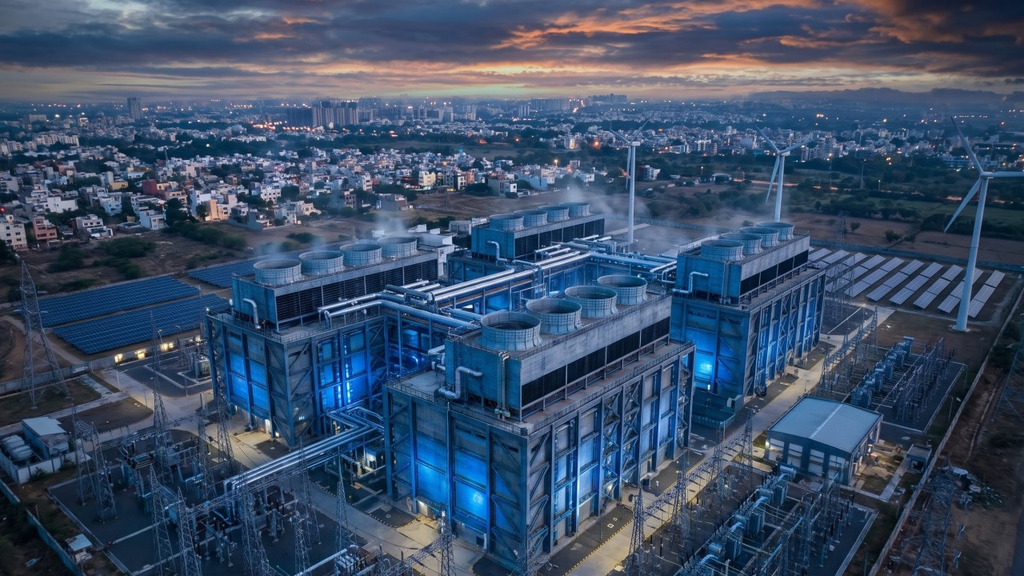
As AI, cloud computing and digital services expand, data centres are becoming one of India’s most critical infrastructure sectors.
Every digital transaction happens somewhere.
Every cloud application, online payment, streaming platform, AI model and enterprise database ultimately depends on physical infrastructure that stores, processes and transfers data.
That infrastructure is the data centre.
India’s data centre industry is now entering a major expansion phase. According to a Savills India estimate reported in July 2026, the country had approximately 1.8 GW of operational IT capacity in H1 2026, with capacity projected to exceed 7 GW by 2030.
The opportunity, however, is not simply about constructing more buildings.
Modern data centres require enormous amounts of power, sophisticated cooling systems, high-speed connectivity, resilient electrical infrastructure and specialised engineering.
India’s digital growth is therefore creating a new infrastructure ecosystem.
AI and Cloud Are Changing the Market
Cloud adoption has been one of the biggest drivers of data centre growth.
Businesses are moving applications, storage and computing workloads from traditional on-premise infrastructure to cloud platforms.
But artificial intelligence is creating an even bigger shift.
AI workloads require large clusters of high-performance processors. These systems consume significantly more electricity and generate considerably more heat than traditional computing environments.
Cushman & Wakefield identifies accelerating AI adoption, hyperscale cloud expansion and growing enterprise demand as major forces driving India’s data centre development pipeline.
This means tomorrow’s data centre cannot simply be a larger version of yesterday’s facility.
It must be designed differently.
Power Is Becoming the Critical Requirement
For data centre developers, access to land is important.
But access to reliable power can be even more important.
A data centre operates continuously, 24 hours a day. Interruptions can affect banking systems, cloud applications, e-commerce platforms and business operations.
Facilities therefore require highly resilient electrical infrastructure, including:
- Utility connections
- Transformers and switchgear
- Uninterruptible Power Supply systems
- Backup generation
- Battery systems
- Protection and control systems
- Redundant power distribution
CBRE notes that power availability is increasingly determining where new data centre capacity can be developed across Asia-Pacific, particularly as AI workloads require higher-density infrastructure.
For India, data centre development is therefore becoming closely connected with investment in electricity generation, transmission and distribution.
Cooling Is Becoming an Engineering Challenge
Almost all electricity consumed by computing equipment eventually becomes heat.
Removing that heat is essential.
Traditional data centres have relied heavily on air-based cooling systems.
AI infrastructure is changing this equation.
As server racks become more power-dense, conventional cooling can become less effective. Developers are consequently evaluating technologies such as:
Direct-to-chip liquid cooling, chilled-water systems, rear-door heat exchangers and advanced thermal-management solutions.
Cooling-system design will increasingly influence energy efficiency, water consumption, equipment reliability and overall operating cost.
Mechanical engineering is therefore becoming just as important as IT infrastructure in the modern data centre.
Data Centres Are Becoming Energy Infrastructure
The rapid growth of computing also creates a sustainability challenge.
Large data centres consume substantial amounts of electricity.
As the sector expands, operators will increasingly need to consider how that electricity is produced.
CBRE expects renewable-power integration, policy support and AI-led demand to remain important drivers of India’s data centre expansion in 2026.
Future campuses may increasingly combine:
Grid Power + Renewable Energy + BESS + Backup Generation + Intelligent Energy Management
Battery Energy Storage Systems can also support backup requirements, peak-load management and integration of renewable electricity.
The boundary between the data centre sector and the energy sector is becoming increasingly narrow.
India’s Data Centre Geography Is Expanding
Mumbai remains the country’s major data centre hub, supported by connectivity, submarine cable infrastructure and a large concentration of businesses.
But the market is broadening.
Hyderabad, Chennai, Delhi NCR, Pune and Bengaluru are also attracting development, while emerging locations are being evaluated for future capacity. Cushman & Wakefield reported around 3.1 GW of Indian capacity under construction and planned in its June 2026 assessment.
Location decisions increasingly depend on a combination of:
- Power availability
- Fibre connectivity
- Land
- Water availability
- Regulatory support
- Renewable-energy access
- Construction ecosystem
- Disaster risk
- Proximity to customers
The next major data centre cluster may therefore be determined as much by infrastructure readiness as by proximity to a traditional technology hub.
Engineering Will Determine Reliability
A data centre is one of the most engineering-intensive building types.
Its successful operation requires multiple disciplines working together.
Electrical Engineering manages power distribution, transformers, UPS systems, switchgear and redundancy.
Mechanical Engineering manages cooling, HVAC, ventilation and thermal performance.
Civil & Structural Engineering supports buildings, equipment loads, site development and infrastructure.
Automation & Controls manage Building Management Systems, Data Centre Infrastructure Management and equipment monitoring.
Fire & Life Safety systems protect highly valuable equipment and maintain operational continuity.
Testing & Commissioning verifies whether all systems perform correctly individually and together before the facility becomes operational.
For mission-critical infrastructure, construction completion is not enough.
The facility must perform reliably under both normal and failure conditions.
The Workforce Opportunity
Rapid expansion will also create growing demand for specialised professionals.
The sector requires expertise across:
- Electrical engineering
- Mechanical and HVAC engineering
- Civil and structural engineering
- Project management
- MEP construction
- Automation and controls
- Quality assurance
- HSE
- Testing and commissioning
- Energy management
- Operations and maintenance
As facilities become larger and AI workloads become more demanding, experienced engineering and project-delivery capability will become an important competitive advantage.
Looking Ahead
India’s data centre industry is evolving from a specialised real-estate segment into critical national digital infrastructure.
Cloud computing created the first major wave.
AI could create the next.
But delivering this growth will require much more than servers and software.
It will require power infrastructure, cooling technology, renewable energy, construction capability, advanced controls and highly skilled engineering teams.
The companies that succeed will be those that can combine:
Digital Technology + Power + Engineering + Sustainability + Execution
Data may be digital.
But the infrastructure supporting it is very physical.
And as India’s digital economy grows, the engineering behind that infrastructure will become more important than ever.
Empowering People. Enabling Projects.