
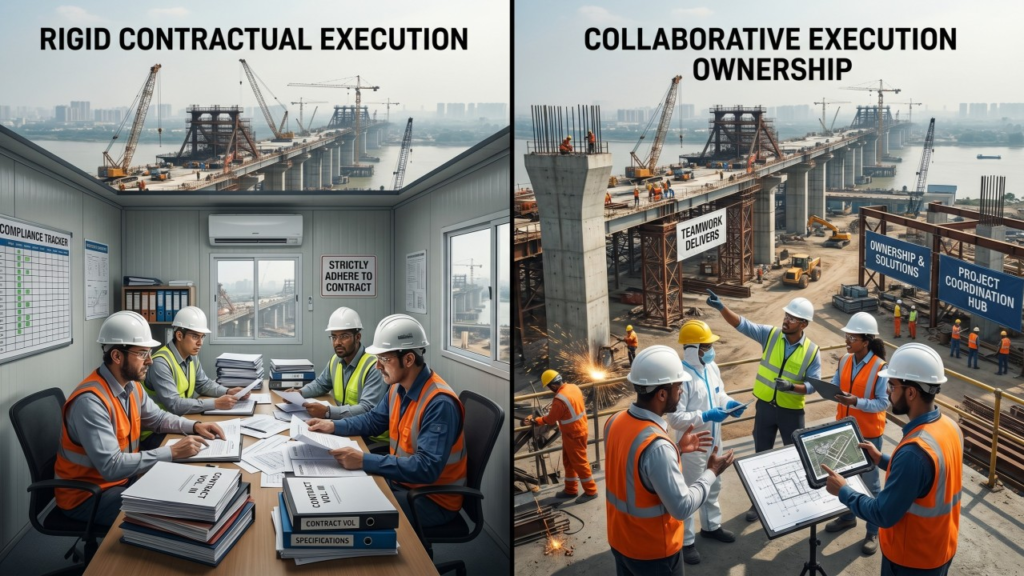
One of the biggest execution challenges in PMC and large infrastructure projects today is not lack of technical capability.
It is lack of alignment between scope ownership and project ownership.
On every major project site, professionals often work under two different pressures simultaneously:
- The PMC leadership drives contractual discipline, reporting structures, compliance, documentation, commercial boundaries, and defined deliverables.
- The Owner’s team drives urgency, execution pressure, milestone achievement, commissioning targets, and business continuity expectations.
And in between stands the project professional — expected to satisfy both.
This creates one of the most difficult questions in project execution:
“Should I strictly stick to my defined scope?” OR “Should I go beyond the scope to ensure the project moves forward?”
This is where most organizations struggle.
Because projects are not executed in ideal boardroom conditions. They are executed in dynamic, high-pressure environments where realities change daily.
A delayed approval from one stakeholder impacts multiple contractors. A small coordination gap affects commissioning timelines. A shutdown extension creates commercial exposure. A missed escalation becomes a project delay. And often, the pressure reaches the site engineer or project manager first — long before leadership discussions happen.
The industry traditionally approached this problem in two extreme ways:
One side says: “Stay within contractual boundaries at all times.”
The other side says: “Do whatever it takes to complete the project.”
Both approaches fail when applied blindly.
Pure scope-based execution creates rigid organizations that struggle during real project pressure.
Pure delivery-based execution creates burnout, uncontrolled scope expansion, accountability confusion, and commercial risk.
At VEN, we believe successful project execution lies in balancing both.
This is exactly where the VEN approach differs from conventional manpower deployment or transactional PMC support.
We do not position our professionals merely as resources filling positions on an organogram.
We position them as project-aligned execution professionals.
Professionals who understand:
• Contractual discipline
- Commercial sensitivity
- Site realities
- Client expectations
- Coordination pressure
- Timeline impact
- Execution urgency
- Governance accountability
Simultaneously.
Because modern projects no longer need people who only “complete assigned activities.”
Projects today require professionals who can:
• Understand the larger execution impact
- Anticipate downstream risks
- Coordinate across stakeholders
- Escalate before delays become crises
- Protect project continuity
- Support delivery without compromising governance
This is the difference between manpower support and execution ownership.
At VEN, our focus is not simply deploying engineers quickly.
Our focus is deploying professionals who can integrate into project ecosystems and think beyond isolated departmental activities.
That is why the industry increasingly requires:
Not just engineers,
But execution-oriented professionals with accountability mindset.
The real challenge in projects today is not availability of manpower.
The real challenge is availability of professionals who can balance:
Scope discipline,
Delivery urgency,
Stakeholder expectations,
And ownership behavior together.
This is why VEN operates with an Owner’s Engineer mindset.
Our teams are trained to understand that:
• Every delay has commercial impact
- Every coordination failure affects multiple stakeholders
- Every unresolved site issue compounds execution pressure
- Every escalation delayed becomes a larger project risk tomorrow
At the same time, we strongly believe ownership must operate with structure.
Ownership does not mean uncontrolled execution. Ownership means responsible execution.
It means:
• Taking initiative with visibility
- Escalating with clarity
- Supporting execution with accountability
- Balancing flexibility with governance
- Understanding where support ends and commercial exposure begins
This balanced approach is what allows projects to move faster without losing control.
Because ultimately, projects do not fail only because of technical issues.
Projects fail when:
• Teams work in silos
- Managers protect only departments
- Stakeholders operate without alignment
- Professionals stop thinking beyond tasks
- Nobody takes ownership during difficult phases
And this is precisely the gap VEN aims to solve.
Not by merely supplying manpower.
But by enabling project execution through professionals who align with project realities, integrate with client environments, and operate with responsibility beyond routine activity completion.
Because in today’s execution-driven industry:
Resources perform tasks.
But ownership-driven professionals move projects forward.