
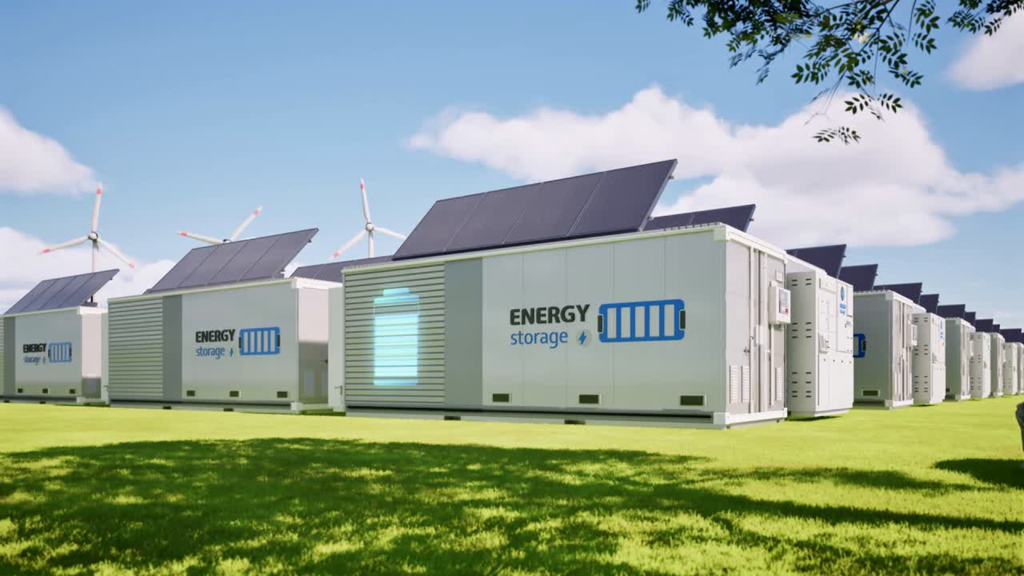
As India rapidly expands solar and wind power, Battery Energy Storage Systems (BESS) are becoming one of the most important pieces of our future energy infrastructure.
But an interesting question is:
Is BESS really a new technology?
The answer is no — and yes.
The concept of storing electricity in large battery systems and returning it to the grid when required has existed for decades.
For example, in Berlin, Germany, a 17 MW / 14 MWh lead-acid battery system was installed in 1986 to support the city’s then-isolated electricity network. It provided frequency regulation and spinning reserve, demonstrating that large batteries could perform important grid-stabilization functions long before today’s renewable-energy boom.
What has changed dramatically is the technology, economics and scale.
Lithium-ion batteries, sophisticated Battery Management Systems (BMS), power electronics and digital energy-management platforms have transformed batteries from relatively specialized grid assets into increasingly scalable infrastructure.
Australia provided one of the strongest demonstrations.
When the Hornsdale Power Reserve entered operation in South Australia in 2017, large-scale batteries suddenly attracted global attention.
It demonstrated that batteries could respond extremely quickly to grid disturbances, participate in energy markets and provide frequency-control services.
The Australian Energy Regulator reported that new technologies including Hornsdale helped drive average frequency-control ancillary-service costs in Q1 2018 57% below the previous quarter. AEMO also documented an event where frequency-control prices fell from historically observed levels of $9,000/MWh to $248/MWh, with an estimated saving of approximately A$3.5 million over five hours.
Hornsdale has since been expanded, with Australia’s renewable-energy agency reporting that the project has supported grid reliability and increased renewable-energy integration.
So BESS is not an experimental concept waiting to be proven.
It is a technology whose commercial application is becoming significantly more sophisticated.
And India has already started its journey.
India’s first grid-scale battery storage system was commissioned at Tata Power Delhi Distribution’s Rohini substation in 2019.
The 10 MW system demonstrated applications including peak-load management, renewable integration, power-quality management and ancillary grid services.
India is now moving from these early projects toward much larger deployment.
Why could the impact on India be particularly significant?
India has an interesting energy challenge.
We are building enormous amounts of solar capacity. But solar produces most strongly during daylight hours, while electricity demand continues well beyond sunset.
This creates a fundamental mismatch:
We may have energy — but not necessarily at the time we need it.
BESS changes that equation.
Excess renewable electricity can be stored when generation is high or electricity is inexpensive and discharged during evening peaks or periods of grid stress.
That can create several benefits:
- Renewable integration → More solar and wind can potentially be absorbed without immediately needing matching consumption.
- Peak management → Stored electricity can be dispatched when demand and power costs are higher.
- Grid stability → Batteries can respond extremely quickly to frequency fluctuations and other grid disturbances.
- Infrastructure optimization → Storage at strategic locations may help relieve stressed transmission and distribution infrastructure.
- Energy security → Storage provides another layer of flexibility between electricity generation and consumption.
And there is another dimension that deserves attention.
BESS could become an engineering and manufacturing opportunity for India.
The opportunity is not limited to manufacturing battery cells.
A complete BESS ecosystem requires:
- Battery cells and modules
- Battery Management Systems (BMS)
- Power Conversion Systems (PCS)
- Energy Management Systems (EMS)
- Transformers and switchgear
- Thermal and fire-safety systems
- SCADA and digital monitoring
- System integration
- EPC and commissioning
- Operations and maintenance
- Battery recycling and second-life solutions
That means BESS can potentially create an entire new engineering-services ecosystem around India’s energy transition.
So, is BESS new?
The technology itself isn’t.
Large grid batteries have existed for decades, and markets such as Germany and Australia have already demonstrated important applications successfully.
What is new is the scale at which India may need to deploy them.
The first chapter of India’s renewable-energy journey was largely about:
“How much clean electricity can we generate?”
The next chapter will increasingly be about:
“How do we store, manage and deliver that electricity exactly when it is needed?”
Solar and wind changed how we generate electricity.
BESS could change how we manage it.
And that may make energy storage one of the most consequential infrastructure and engineering opportunities in India’s next decade.