
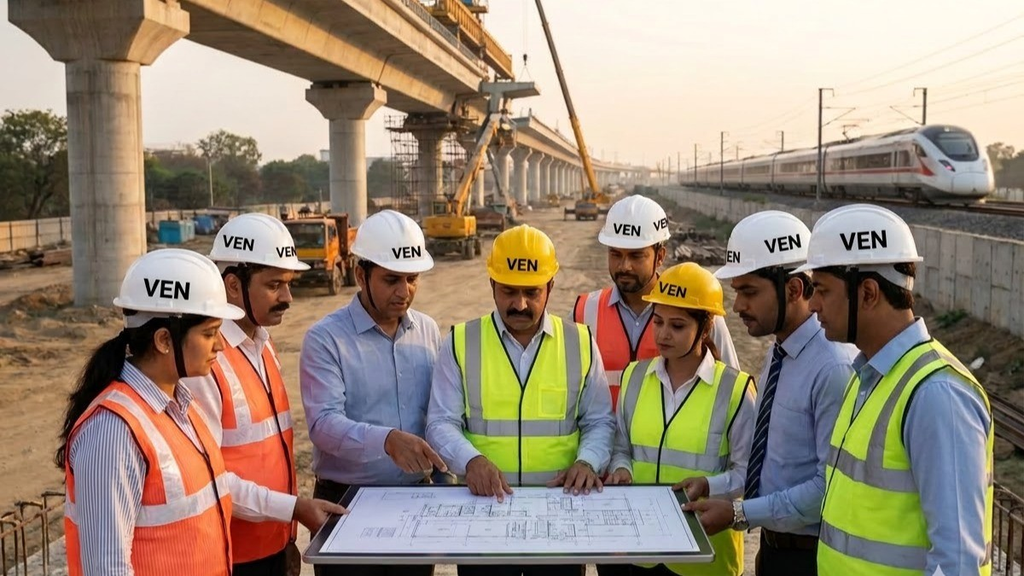
As cities expand and economic corridors grow, metro and high-speed rail are becoming critical infrastructure for India’s next phase of urban and regional connectivity.
India’s mobility landscape is undergoing a significant transformation.
Rapid urbanisation, rising population density, increasing road congestion and growing economic activity are creating demand for transportation systems that can move large numbers of people faster, safer and more efficiently.
At the centre of this transformation are Metro Rail and High-Speed Rail systems.
India’s operational metro network had expanded to approximately 1,155 km across 26 cities by March 2026, compared with just 248 km across five cities in 2014. This growth has positioned India among the world’s largest metro rail markets.
At the same time, the country is developing its first high-speed rail corridor, creating an entirely new ecosystem of specialised railway technology, construction and engineering capability.
The opportunity is no longer simply about building railway tracks.
It is about creating an integrated mobility infrastructure capable of reshaping how Indian cities and economic regions function.
Metro Rail Is Becoming Essential Urban Infrastructure
As Indian cities grow, road infrastructure alone cannot solve mobility challenges.
Metro systems can move large numbers of passengers through densely populated areas while reducing pressure on roads and providing predictable journey times.
Metro networks are increasingly becoming part of broader urban ecosystems connecting:
· Residential areas
· Business districts
· Railway stations
· Airports
· Bus terminals
· Industrial corridors
· Commercial centres
The value of metro infrastructure therefore extends beyond transportation.
Improved connectivity can influence real-estate development, employment accessibility, commercial activity and the overall structure of a city.
The future of urban mobility will increasingly depend on how effectively metro systems integrate with buses, suburban rail, airports, pedestrian infrastructure and other modes of transportation.
High-Speed Rail Is Creating a New Engineering Ecosystem
While metro systems transform travel within cities, high-speed rail has the potential to reshape travel between major cities.
India’s first major high-speed rail programme—the Mumbai–Ahmedabad corridor—extends approximately 508 km across Maharashtra, Gujarat and Dadra & Nagar Haveli, with 12 planned stations.
The importance of the project extends beyond travel time.
High-speed rail requires a completely different level of infrastructure and engineering precision.
The system involves:
Viaducts + Tunnels + Bridges + Stations + High-Speed Track + Electrification + Signalling + Communication + Control Systems
Developing these capabilities is helping create technical knowledge that could support future high-speed rail corridors across the country.
High-speed rail is therefore not simply another railway project.
It represents the development of an entirely new transportation technology ecosystem.
Stations Are Becoming Mobility Hubs
The role of railway stations is also changing.
Traditionally, stations were primarily locations where passengers boarded or exited trains.
Modern metro and high-speed rail stations are increasingly designed as integrated mobility and commercial hubs.
A well-designed station can connect multiple transport systems while supporting retail, offices, public spaces and surrounding urban development.
This creates opportunities for Transit-Oriented Development, where residential and commercial development is concentrated around mass-transit corridors.
The result is a shift from building isolated transport infrastructure toward building connected urban ecosystems.
Engineering Complexity Is Increasing
Rail infrastructure involves some of the most multidisciplinary projects in the construction sector.
Metro and high-speed rail projects require expertise across:
Civil & Structural Engineering — viaducts, bridges, tunnels, stations and foundations.
Track Engineering — alignment, track systems, vibration control and high-precision installation.
Electrical Engineering — traction power, substations, distribution and auxiliary systems.
Signalling & Telecommunications — train control, communication, passenger information and operational safety.
MEP Engineering — ventilation, HVAC, fire protection, elevators, escalators and station utilities.
Systems Integration — ensuring trains, tracks, signalling, power and station systems operate as one network.
Testing & Commissioning — validating every system before passenger operations begin.
High-speed rail raises these requirements further because speed significantly increases the importance of track geometry, structural tolerances, signalling reliability and operational safety.
Underground Construction Remains a Major Challenge
Many metro corridors must pass through dense urban environments where surface construction is difficult.
This makes underground construction increasingly important.
Tunnel Boring Machines can excavate beneath cities, but underground projects involve complex geological, structural and logistical challenges.
Engineering teams must manage:
· Variable soil conditions
· Existing buildings
· Underground utilities
· Groundwater
· Restricted construction areas
· Traffic management
· Settlement monitoring
· Worker safety
High-speed rail also introduces major tunnelling requirements where geography or dense urban development prevents conventional surface alignment.
Successful tunnelling depends heavily on geotechnical understanding, monitoring and execution discipline.
Technology Is Transforming Rail Operations
Modern rail networks are becoming increasingly digital.
Automatic Train Control, Communication-Based Train Control, predictive maintenance, intelligent signalling and centralised operations centres are improving capacity and reliability.
Sensors can continuously monitor tracks, rolling stock and electrical equipment.
Data analytics can help maintenance teams identify failures before they disrupt operations.
Future rail systems may increasingly combine:
Physical Infrastructure + Automation + Data + Predictive Maintenance
This means rail infrastructure is becoming both an engineering system and a digital system.
The Workforce Opportunity
India’s expanding rail programme will create sustained demand for specialised professionals.
The sector requires expertise across:
· Civil and structural engineering
· Geotechnical engineering
· Track engineering
· Electrical and traction systems
· Signalling and telecommunications
· MEP
· Project planning
· Contract management
· Quality assurance
· HSE
· Construction management
· Testing and commissioning
As projects become larger and technologically more sophisticated, professionals who understand both infrastructure construction and complex rail systems will become increasingly valuable.
Looking Ahead
India’s metro and high-speed rail journey is ultimately about more than transportation.
It is about creating cities where people can move efficiently and economic regions where distance becomes less of a barrier.
Metro rail will continue transforming urban mobility.
High-speed rail can transform intercity connectivity.
Together, they are creating opportunities across construction, manufacturing, technology, engineering and project management.
The success of this transformation will depend on the industry’s ability to combine:
Infrastructure + Technology + Engineering + Safety + Execution + Talent
Because trains may move people.
But engineering moves cities and economies forward.
Empowering People. Enabling Projects.