
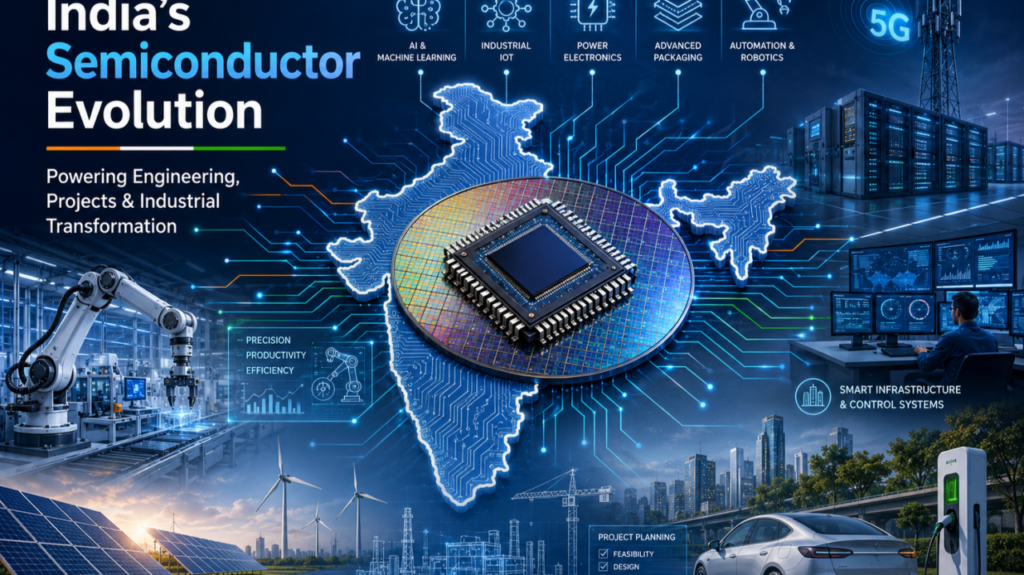
India’s semiconductor industry is entering a decisive growth phase, and its impact will extend far beyond chip manufacturing. For the engineering, infrastructure, EPC, manufacturing, automation, and industrial project sectors, semiconductors are becoming a strategic enabler of smarter, faster, safer, and more efficient execution.
The latest trends in the semiconductor ecosystem clearly show where the future is heading. Artificial intelligence, electric mobility, 5G/6G communication, renewable energy, smart factories, data centres, defence electronics, industrial IoT, robotics, and advanced automation are all increasing demand for high-performance chips, sensors, microcontrollers, power semiconductors, embedded systems, and advanced packaging technologies.
For project-based industries, this shift is highly significant. Large-scale engineering projects today depend on intelligent control systems, predictive maintenance, real-time monitoring, energy management, precision instrumentation, safety automation, and connected equipment. Each of these solutions depends on semiconductor-enabled hardware. Whether it is a smart manufacturing plant, metro rail project, EV charging infrastructure, solar power facility, data centre, oil and gas installation, or industrial automation system, semiconductor availability directly influences project reliability, execution timelines, and lifecycle performance.
One of the most important trends is the growing focus on power electronics and compound semiconductors such as silicon carbide and gallium nitride. These technologies are critical for electric vehicles, renewable energy inverters, high-efficiency drives, industrial power systems, and grid modernization. For engineering companies, this means better energy efficiency, compact system design, improved thermal performance, and stronger reliability in demanding operating environments.
Another key development is advanced packaging, OSAT, and ATMP capabilities. As chips become more complex, packaging is no longer just a back-end process; it is becoming a performance differentiator. This is especially relevant for AI hardware, automotive electronics, telecom systems, and industrial automation platforms. India’s growing capabilities in this area can support faster localization, better supply chain control, and reduced dependency on imported electronic modules.
The rise of AI-driven engineering is also transforming how projects are designed and maintained. Semiconductor-enabled edge devices can collect and process data directly at machines, plants, and project sites. This supports predictive maintenance, digital twins, remote monitoring, quality inspection, automated safety checks, and faster decision-making. For EPC and engineering teams, this creates a shift from reactive project management to data-driven project intelligence.
India’s semiconductor momentum will also create new opportunities for engineering talent. The industry will require skilled professionals in chip design, embedded systems, automation, process engineering, testing, reliability, cleanroom operations, equipment maintenance, project planning, and quality assurance. This will strengthen collaboration between engineering companies, manufacturers, technology providers, research institutions, and infrastructure developers.
At Ven India, we believe the semiconductor revolution will be a powerful catalyst for India’s engineering-led growth. It will strengthen domestic manufacturing, improve project resilience, enable smarter industrial systems, and support India’s vision of technological self-reliance.
The future of semiconductors is not only about producing chips. It is about empowering every machine, every plant, every infrastructure project, and every engineering solution that will shape India’s next decade of industrial progress.